Knowing Author Deborshi Barat- Talk Time With Samata
In this session of Talk Time with Samata, I am delighted to welcome Deborshi, a multifaceted personality whose journey beautifully bridges the worlds of law, public policy, academia, theatre, cinema and literature. A lawyer and public-policy advisor by profession, and a storyteller by instinct, Deborshi brings a fascinating blend of intellectual depth, creative curiosity and an astute understanding of human relationships to his writing.
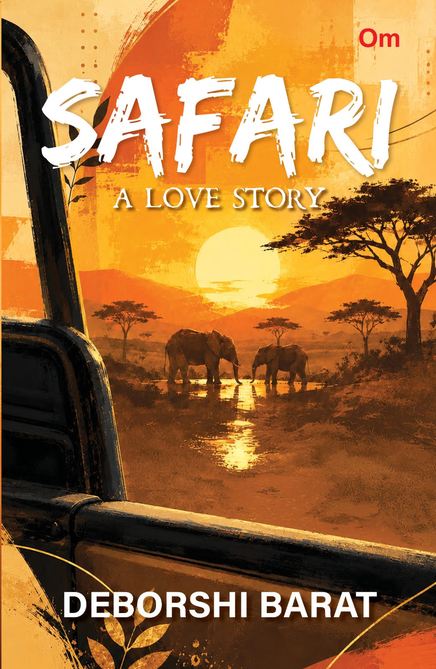
His latest novel, Safari – A Love Story, takes readers on an evocative journey through the landscapes of East Africa, exploring love, betrayal, friendship, identity and self-discovery. In this candid conversation, we delve into the inspirations behind the novel, the emotional journeys of its characters, the wilderness within us, and how life’s unexpected turns can open doors to transformation and freedom. Let’s get to know the mind and creative world behind this intriguing story.
1. Welcome to Talk Time with Samata. Deborshi, kindly introduce yourself to my readers who are keen to know about you, your education, family and what you do beyond writing wonderful stories.
Thank you, Samata. It is a pleasure to be here and to have this opportunity to connect with your readers.
I am a lawyer and public-policy advisor by training and profession, including an academic stint, and a storyteller by instinct. My life has taken me through rather different worlds, from corporate law and international affairs to university classrooms, on the proscenium and in front of the camera, and also to fiction writing. I have always been interested in people, the choices they make, the worlds they inhabit, and the circumstances that shape their lives. In retrospect, perhaps there is a common thread running through these seemingly disparate pursuits: an enduring curiosity about human behaviour.
I grew up in Kolkata and attended St. Xavier’s Collegiate School before pursuing law at the National University of Juridical Sciences (NUJS). My subsequent academic journey took me to the United States, where I studied at The Fletcher School at Tufts University, earning an M.A. in Law and Diplomacy and subsequently a PhD. I also completed an LL.M., cross-registering for Law and Politics at the Harvard Law School. My doctoral research examined the sociological legitimacy of dispute-resolution mechanisms in international investment law and received the Peter Ackerman Doctoral Dissertation Award.
Professionally, I began with corporate and commercial law, including capital markets and mergers and acquisitions. I subsequently worked in international trade and economic advisory, before moving into academia. I was an Associate Professor at Jindal Global Law School, where I taught several subjects, including contracts, M&A, comparative public law and international investment law, and also served as Assistant Dean. I currently head public policy and knowledge management at a law firm in New Delhi, working principally on regulatory and policy issues concerning emerging technologies, data protection, artificial intelligence, clean energy and ESG.
Beyond my professional life, theatre and acting has been a particularly persistent interest. I have acted in English-language plays, Bengali films and television, and continue to remain associated with the performing arts. I am also a Director of Theatrecian, an English-language theatre group. I enjoy debating, reading, writing on subjects beyond my immediate professional interests, and engaging with questions of history, culture, politics and international affairs.
As for family, my parents stay in Kolkata. I have no siblings, which is a pity, but the absence is adequately compensated by my cousins, with whom I continue to be close.
I suppose that a variety of my experiences has given me a somewhat eclectic perspective on life. Each has offered a different vantage point from which to observe people, relationships and the societies we inhabit. Writing fiction gives me the opportunity to bring many of these observations together in a more personal and imaginative form.
2. The Inspiration Behind Safari – A Love Story brings together love, betrayal, friendship, identity and self-discovery against the backdrop of Africa. What inspired you to weave these diverse themes into one narrative? Was there a particular experience, observation or idea that gave birth to this story?
The starting point for Safari – A Love Story was an interest in the many different ways in which our lives are shaped by relationships, expectations, circumstances and decisions that we sometimes make without fully understanding their implications. We often think of our lives as a reasonably coherent progression of choices. In reality, they are frequently shaped by events, encounters and relationships that disrupt the trajectories we had imagined for ourselves.
I was particularly interested in the relationship between personal identity and the lives we inherit or gradually construct around ourselves. There are expectations imposed by family, society and culture, alongside those we internalise so completely that we eventually mistake them for our own desires. Love, betrayal, friendship and self-discovery offered different ways of examining these questions.
Africa provided an extraordinarily evocative setting for this exploration. East Africa, particularly Kenya and Tanzania, possesses an extraordinary geographical, cultural and historical richness. Its landscapes, wildlife, communities, histories and folklore offer a world that is both visually compelling and intellectually fascinating. The physical journey through these places also provided a narrative space in which the characters could encounter different perspectives, relationships and possibilities.
I was equally interested in writing a love story that would have several layers to it. Love is a powerful experience, but it is also complicated by memory, insecurity, ambition, social expectations and the histories people bring into their relationships. The same is true of friendship, which can be as formative as romantic love, sometimes even more enduring.
Ultimately, the themes came together because they are interconnected aspects of human experience. A journey through unfamiliar places can lead to encounters with unfamiliar people; those encounters can challenge familiar beliefs; and sometimes the greatest discoveries concern the person we have been all along, without quite recognising it.
3. Niharika’s Emotional Journey – Niharika Bose begins her journey after experiencing a devastating personal betrayal. How did you approach creating her character? Did you intend her journey to be primarily about healing from heartbreak, discovering her identity, or finding the courage to challenge the life she had always accepted?
Niharika was perhaps one of the most interesting and challenging characters to write. I wanted her to be a recognisably human character, with contradictions, vulnerabilities, aspirations and occasional uncertainties. She is someone whose understanding of herself and her place in the world evolves through her experiences.
The betrayal that sets her journey in motion is significant because it disrupts the emotional and psychological equilibrium she has come to accept. Such experiences can make us question the people around us, but they can also provoke more uncomfortable questions about our own choices, compromises and expectations. When something we have taken for granted suddenly collapses, we are sometimes compelled to examine the foundations on which we have built our lives.
For me, Niharika’s journey operates on several levels simultaneously. There is certainly an element of healing from emotional hurt, but I was more interested in what happens beyond the immediate experience of heartbreak. What does a person discover when familiar relationships and assumptions cease to provide the reassurance they once did? How does one distinguish between genuine personal desires and expectations absorbed over years of living within particular social and emotional structures?
There was also the challenge of exploring a woman’s inner world as a male writer. I approached this through observation, empathy and an effort to understand the particular pressures, negotiations and contradictions that can inform women’s lives. I was conscious of avoiding the temptation to make Niharika represent an entire category of women. She needed to remain an individual, with her own temperament, sensibilities, imperfections and agency.
I would say that her journey is ultimately about reclaiming authorship over her own life. Heartbreak initiates the process; self-discovery deepens it; and the possibility of making choices on her own terms gives it direction.
4. Love, Betrayal and Freedom – The novel explores how betrayal can sometimes become the beginning of transformation. Do you believe that certain emotional upheavals are necessary for people to question their choices and rediscover themselves? How does Niharika’s journey reflect this idea?
I think emotional upheavals can sometimes become powerful moments of reckoning. Most of us develop patterns of living that provide a certain degree of security and continuity. We make compromises, accommodate other people’s expectations, and gradually become accustomed to particular relationships and circumstances. Over time, we may cease to question whether the lives we lead genuinely reflect who we are or what we want.
A significant betrayal can disturb this equilibrium. It can expose vulnerabilities, challenge assumptions and compel us to revisit decisions that we might otherwise have continued making almost unconsciously. In that sense, adversity can become an occasion for introspection and transformation.
However, I would be reluctant to romanticise suffering or suggest that people need to experience betrayal to discover themselves. Growth can emerge from affection, intellectual curiosity, travel, friendship and the ordinary accumulation of life experiences. Sometimes, though, it takes a particularly difficult experience to bring certain questions into focus.
In Niharika’s case, betrayal becomes the catalyst for a larger process of questioning. She begins to confront the difference between the life she has accepted and the life she might have chosen under different circumstances. The process involves emotional vulnerability, uncertainty and moments of self-doubt. Freedom, as she gradually discovers, carries its own responsibilities. It requires the willingness to make choices, live with their consequences, and accept the uncertainty that accompanies any genuinely independent decision.
I suppose that is one of the ideas I wanted the novel to explore: occasionally, the circumstances that unsettle us most profoundly also create the possibility of seeing ourselves and our lives differently.
5. The Intriguing Character of Vania Vyas – Vania is brilliant, magnetic and unpredictable. She plays a significant role in changing the direction of Niharika’s life. What does Vania represent in the story? Is she simply a catalyst for Niharika’s transformation, or does she have her own deeper emotional journey?
Vania is one of those characters who can alter the atmosphere of a story simply by entering it. She is intelligent, charismatic, unconventional and, in many respects, difficult to anticipate. There is an immediacy to her personality that makes her compelling, although her magnetism is accompanied by complexities that gradually become apparent.
I saw Vania as an important counterpoint to Niharika. The two women approach life, relationships and the possibilities available to them from different positions. Their differences are significant because they enable each to encounter perspectives that might otherwise have remained outside her immediate experience. Vania brings into Niharika’s world a certain disruption of familiar assumptions. She expands the range of possibilities that Niharika is able to imagine.
However, I would not want Vania to be understood merely as a device for someone else’s development. She has her own personality, impulses, contradictions and emotional vocabulary. People who appear particularly confident or self-assured often have private histories and vulnerabilities that are not immediately visible. Their apparent freedom may also come with its own costs.
I have always found such contradictions interesting in characterisation. We tend to form impressions of people based on the confidence they project, the choices they make or the way they conduct themselves. Understanding them more deeply requires moving beyond those first impressions.
Vania’s relationship with Niharika therefore works in several ways. It is about friendship, influence, contrasting temperaments and the sometimes unpredictable ways in which one person can change another’s understanding of life. I hope readers will find her as intriguing and difficult to categorise as I did while writing her.
6. The Chemistry Between Niharika and Dr Srinivas Rajan – The relationship between Niharika and Dr Srinivas develops through unexpected circumstances, shared experiences and unspoken emotions. How did you develop their chemistry? Did you consciously want their relationship to challenge conventional ideas of love and companionship?
I have always believed that relationships become interesting when they are allowed to develop beyond familiar romantic conventions. Chemistry between two people can arise from attraction, certainly, but it can also emerge from intellectual compatibility, shared experiences, mutual curiosity, emotional recognition and an understanding that develops gradually through conversation and silence.
In writing Niharika and Dr Srinivas Rajan, I was interested in exploring precisely these dimensions. Their relationship develops through circumstances neither necessarily anticipates. There is an element of the unexpected, and the connection between them acquires significance through their interactions and the experiences they share.
I was particularly interested in the unspoken aspects of human relationships. We communicate a great deal through what we choose to say, but sometimes even more through hesitation, silence, gestures and the things we find difficult to articulate. These nuances can create an emotional connection that is more persuasive than grand declarations.
I also wanted their relationship to be situated within the larger emotional journeys of the characters. People rarely enter relationships as blank slates. They bring memories, insecurities, expectations, previous experiences and sometimes unresolved questions about themselves. Attraction and companionship consequently involve an engagement with another person’s history as much as with their present personality.
For me, the interesting question is what makes two people recognise something in each other, and how that recognition changes their understanding of companionship. Love need not always conform to a prescribed sequence of events or expectations. Its meaning is shaped by the individuals involved, their circumstances and their willingness to understand one another.
7. Sensuality as a Literary Expression – The book blends sensual storytelling with emotional vulnerability. How do you balance sensuality with the deeper psychological and emotional dimensions of your characters? What role does physical attraction play in revealing the complexities of human relationships?
I think sensuality is an important dimension of human experience, and literature should be able to engage with it naturally. Physical attraction, intimacy and desire are among the ways through which people experience and express themselves. They can reveal confidence, vulnerability, insecurity, longing and the desire for emotional connection.
The interesting part, from a literary perspective, is the relationship between the physical and the psychological. Intimacy is rarely experienced in isolation from a person’s emotional state, memories, expectations or sense of self. The same physical encounter can carry very different meanings depending on the people involved and the circumstances in which it occurs.
In Safari, I wanted sensuality to emerge organically from the characters and their relationships. It forms part of the emotional landscape of the novel, alongside affection, uncertainty, attraction, apprehension and the more complicated aspects of human attachment.
There is also something revealing about the vulnerability that accompanies physical intimacy. People who are otherwise confident and self-assured may become uncertain in situations involving emotional exposure. Desire can coexist with hesitation; attraction with apprehension; intimacy with the fear of being misunderstood or hurt.
I am interested in these contradictions because they make relationships human. Sensuality, when approached with sensitivity, can communicate dimensions of character that conventional dialogue sometimes cannot. It can also remind us that our emotional and physical selves are deeply interconnected.
Ultimately, I wanted the treatment of sensuality to contribute to the emotional and psychological authenticity of the story, rather than exist separately from it.
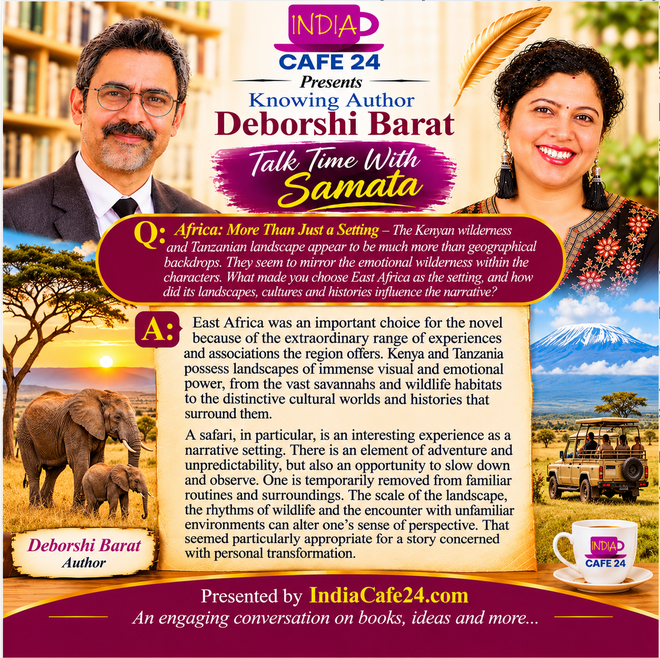
8. Africa: More Than Just a Setting – The Kenyan wilderness and Tanzanian landscape appear to be much more than geographical backdrops. They seem to mirror the emotional wilderness within the characters. What made you choose East Africa as the setting, and how did its landscapes, cultures and histories influence the narrative?
East Africa was an important choice for the novel because of the extraordinary range of experiences and associations the region offers. Kenya and Tanzania possess landscapes of immense visual and emotional power, from the vast savannahs and wildlife habitats to the distinctive cultural worlds and histories that surround them.
A safari, in particular, is an interesting experience as a narrative setting. There is an element of adventure and unpredictability, but also an opportunity to slow down and observe. One is temporarily removed from familiar routines and surroundings. The scale of the landscape, the rhythms of wildlife and the encounter with unfamiliar environments can alter one’s sense of perspective. That seemed particularly appropriate for a story concerned with personal transformation.
I was also interested in the region’s cultural and historical richness. Africa has often been represented in literature and popular imagination through a relatively narrow set of images. I wanted the setting to have a more textured presence in the narrative, with its communities, traditions, folklore, histories and social realities forming part of the world through which the characters move.
There is also a certain narrative relationship between the physical wilderness and the inner lives of the characters. The wilderness can be beautiful, exhilarating, unsettling and occasionally intimidating. Human relationships possess many of the same qualities. We may believe we understand the terrain ahead of us, only to discover that it contains unexpected obstacles, unfamiliar possibilities and paths we had not considered.
I wanted the landscapes to contribute to the atmosphere and emotional movement of the story. In that sense, Africa becomes part of the novel’s imaginative and emotional architecture. It is a place the reader travels through, but also a setting against which the characters’ own journeys acquire greater meaning.
9. Law, Morality and Human Complexity – Your professional background in law and public policy is reflected in the international criminal law elements of the novel. How has your experience as a lawyer and academic influenced your understanding of morality, justice, human behaviour and the grey areas between right and wrong?
My professional experiences have certainly influenced the way I look at human behaviour, particularly the relationship between individual choices, social institutions and the larger circumstances in which people find themselves.
Law is fundamentally concerned with questions of conduct, responsibility, rights and consequences. Yet, anyone who has studied or practised law for a reasonable length of time will appreciate that the relationship between legality and morality is often considerably more complicated than it initially appears. What is legally permissible may not always be morally persuasive; what appears straightforward in principle can become considerably more complicated when examined against the circumstances of an individual case.
My academic work in international investment law, constitutionalism and comparative public law, as well as my engagement with international criminal law and human rights, exposed me to some particularly difficult questions concerning responsibility, accountability, institutional legitimacy and justice. My work with Transparency International on reparations for victims of grand corruption, and my involvement in human-rights advocacy and judicial capacity-building, also brought me into contact with the human consequences of institutional failures and exercises of power.
These experiences have made me particularly conscious of the importance of context. Human conduct is influenced by personal histories, social conditioning, economic circumstances, cultural expectations and the exercise of power. Understanding behaviour requires an appreciation of these influences, even when one must ultimately assess the consequences of particular actions.
I think this perspective has found its way into my fiction. I am interested in characters who cannot be understood through simple moral classifications. People are capable of generosity and selfishness, courage and cowardice, affection and betrayal, sometimes within the same relationship. Their motivations can be contradictory, and their decisions can have consequences they never anticipated.
International criminal law also brings into focus the relationship between individual responsibility and larger historical and political circumstances. It raises questions about how societies remember wrongdoing, how justice is pursued, and how individuals and institutions negotiate accountability. These are compelling questions for a writer because they illuminate the complexity of human relationships and moral choices.
10. Breaking Away from Societal Expectations – Niharika has spent much of her life following expectations and choosing compromise over personal freedom. Why do you think people often struggle to break away from socially prescribed roles, even when those roles make them unhappy? Is personal freedom ultimately about making choices or accepting their consequences?
I think one of the most interesting paradoxes of human existence is that we often desire freedom while simultaneously seeking the security offered by familiarity, acceptance and social belonging.
From an early age, we absorb expectations about the lives we should lead, the relationships we should cultivate, the responsibilities we should assume and the choices that are considered appropriate. These expectations are transmitted through family, education, culture, social structures and, eventually, our own experiences. Over time, they become internalised. We may begin to regard certain decisions as inevitable or certain aspirations as beyond the realm of possibility.
There are also very practical considerations. Financial security, family responsibilities, social acceptance and emotional dependence can make it difficult to depart from established patterns. The prospect of freedom can be exhilarating, but it can also be unsettling because it requires us to relinquish the certainty of familiar arrangements.
I think Niharika’s journey explores this tension particularly well. Her experiences gradually compel her to examine the assumptions and compromises that have shaped her life. She is confronted with the possibility that some of the boundaries she has accepted may have been sustained as much by habit and expectation as by genuine personal conviction.
For me, personal freedom involves both the ability to make choices and the willingness to accept responsibility for them. Choice without responsibility can become little more than impulse; responsibility without choice can become an exercise in resignation. A meaningful sense of autonomy requires an understanding of both.
There is also an important distinction between making a choice and knowing whether it is the right one. We rarely possess complete information about the future. Sometimes we must act despite uncertainty, accept that our decisions may involve sacrifice, and retain the capacity to reconsider them as circumstances change.
I suppose the broader idea is that a life genuinely belonging to us requires a degree of conscious participation in its making. We may not control every circumstance, but we can remain attentive to the extent to which our decisions reflect our own convictions.
11. The Motif of the Wilderness Within – The description of Safari suggests that the most transformative journey is not necessarily across the wilderness but within oneself. What does the wilderness symbolise in your novel? Do you believe that stepping into the unknown is sometimes the only way to discover our authentic selves?
The wilderness operates on both a literal and metaphorical level in the novel. There is, of course, the extraordinary physical landscape of East Africa, with its vastness, unpredictability and capacity to inspire both wonder and apprehension. But it also represents something more personal: the unfamiliar territory within ourselves that we may spend considerable portions of our lives avoiding.
Most of us develop a certain understanding of who we are. We become comfortable with particular identities, relationships and expectations. These provide continuity and a sense of belonging. Yet, there are dimensions of our personalities and aspirations that remain unexplored, sometimes because circumstances have never required us to confront them, and sometimes because doing so would disturb the familiar order of our lives.
Stepping into unfamiliar surroundings can create an opportunity to examine these assumptions. Physical distance from familiar people, routines and responsibilities can offer a different perspective on one’s life. Travel has that curious ability to make the familiar appear unfamiliar and the unfamiliar unexpectedly intimate.
However, I would not suggest that everyone needs to undertake an extraordinary journey or experience a dramatic upheaval to discover themselves. Self-discovery can happen through relationships, difficult conversations, and even quiet moments of reflection.
I am also somewhat sceptical of the notion that there is a single, perfectly defined authentic self which is waiting to be discovered. Human beings evolve. Our identities are shaped and reshaped by experience, relationships, choices and the passage of time. Perhaps authenticity lies in recognising these changes and developing the courage to live with greater honesty and self-awareness.
For Niharika, the journey through the wilderness becomes inseparable from this process of personal exploration. The unknown is both unsettling and liberating. And sometimes, it is precisely when familiar reference points disappear that we begin to recognise possibilities we had never previously imagined.
12. From The Hunter of Pigeons to Safari – Your debut novel, The Hunter of Pigeons, was published in 2014, and now you return with Safari – A Love Story. How has your journey as a writer evolved over the years? Have your experiences in law, academia, theatre and cinema changed the way you observe people and tell stories?
There is a considerable interval between The Hunter of Pigeons, which was published in 2014, and Safari – A Love Story. Naturally, a great deal has happened during that period, both professionally and personally. My engagement with law, academia, public policy, theatre and other pursuits has continued to evolve, and I think these experiences have inevitably influenced my perspective as a writer.
I have always found the process of observing people fascinating. Every profession offers a different window into human behaviour. Legal practice introduces you to the complexity of competing interests, motivations and interpretations. Academia encourages you to question assumptions and examine familiar ideas from different intellectual perspectives. Public policy brings you into contact with the relationship between individual lives and larger social, economic and institutional forces.
Theatre and cinema offer a rather different education. Acting requires you to inhabit a character, understand the motivations behind words and actions, and appreciate the significance of gesture, silence, hesitation and emotional expression. It also teaches you that people rarely reveal everything they feel or think. Sometimes a character becomes most interesting precisely at the point where what is being said diverges from what is being experienced.
I believe these experiences have made me more attentive to the subtleties and contradictions of human relationships. They have also strengthened my interest in character development and the circumstances in which people make decisions.
My approach to fiction has consequently become increasingly interested in psychological complexity, relationships and the broader social and cultural environments in which individuals live. With Safari, I wanted to explore a larger narrative canvas, bringing together travel, romance, friendship, identity, memory and questions of personal freedom.
I also think one’s relationship with writing changes with time. You become more conscious of the importance of voice, narrative structure and the emotional lives of characters. You become increasingly interested in what remains unsaid, in ambiguities, and in allowing readers to draw their own conclusions.
I do not necessarily see the two novels as stages in a linear progression. Each belongs to its own imaginative world. But the intervening years have certainly enriched the experiences and observations I bring to my writing.
13. A Message for Your Readers – If readers take away just one thought or emotion from Safari – A Love Story, what would you want it to be? And as a final thought, what would you say to someone who is standing at a crossroads in life, afraid to leave behind the familiar and embrace the unknown?
If there is one thought I would like readers to take away from Safari, it is that our lives remain open to possibility, even when we have become accustomed to thinking of them in particular ways.
We are shaped by our past, our relationships, our circumstances and the expectations of the people around us. These influences are important, sometimes indispensable. But they need not determine every aspect of who we become. There is always room for reflection, change, reinvention and the discovery of possibilities that may have remained unexplored.
I would also like readers to reflect on the importance of human relationships. Love and friendship, in particular, can influence our lives in profound ways. They can provide reassurance and belonging, challenge our assumptions, expose our vulnerabilities and sometimes introduce us to dimensions of ourselves that we had never encountered. Some relationships accompany us for a lifetime; others may be significant precisely because they change the direction of our lives.
As for someone standing at a crossroads, I would say that apprehension is entirely natural. The familiar, even when imperfect, offers a certain measure of security. The unknown requires us to confront uncertainty, and there is no guarantee that every decision will lead to the outcome we imagine.
But I think it is equally important to consider the cost of remaining where we are simply because change is uncomfortable. There are occasions when continuing along a familiar path requires its own form of compromise, perhaps even a gradual surrender of things that matter to us.
I would encourage such a person to examine their choices honestly, understand their responsibilities, and recognise the difference between a decision made out of genuine conviction and one made primarily out of fear. Courage does not necessarily mean making dramatic departures or abandoning everything familiar. Sometimes it begins with a small decision to acknowledge what one truly wants.
And perhaps the most important thing is to remember that uncertainty is an inherent part of living. We cannot always know where a particular journey will take us. We can, however, decide whether we are willing to undertake it.
14. If Niharika Bose were sitting across from you today, what is the one question you would ask her—and what do you think her answer would reveal about the journey she has undertaken?
I think I would ask Niharika: “Having travelled so far, and having encountered so much, do you think you have finally discovered who you are, or have you simply become more comfortable with the possibility that you are still discovering yourself?”
I suspect she would take a little time before answering. Niharika’s journey is, in many ways, about moving beyond the need for certainty. At the beginning, she is confronted with circumstances that unsettle her understanding of her relationships and herself. As the journey unfolds, she encounters people, places and experiences that challenge her assumptions and broaden her understanding of what life might hold.
I imagine she might say that she has not arrived at any definitive answer. She may have discovered things about herself that she had previously overlooked, recognised desires she had hesitated to acknowledge, and learnt to approach uncertainty with greater acceptance. But she would probably also acknowledge that self-discovery is an ongoing process.
Perhaps that is the most interesting aspect of her journey. We often imagine transformation as arriving at a destination, a moment when everything suddenly becomes clear. In reality, personal growth is usually more gradual and untidy. It involves revisiting old beliefs, changing perspectives, making mistakes and occasionally surprising ourselves.
I would like to think that Niharika has emerged with a greater sense of agency and a more honest relationship with herself. She may not have all the answers, but she is perhaps more comfortable asking the questions.












Leave a Reply