Beyond the Classroom: How Indian Families Can Turn Festivals, Books, Food and Local Travel into Everyday Learning
Beyond the Classroom: How Indian Families Can Turn Festivals, Books, Food and Local Travel into Everyday Learning
By Sumit Kapoor, Founder, LyfSkills
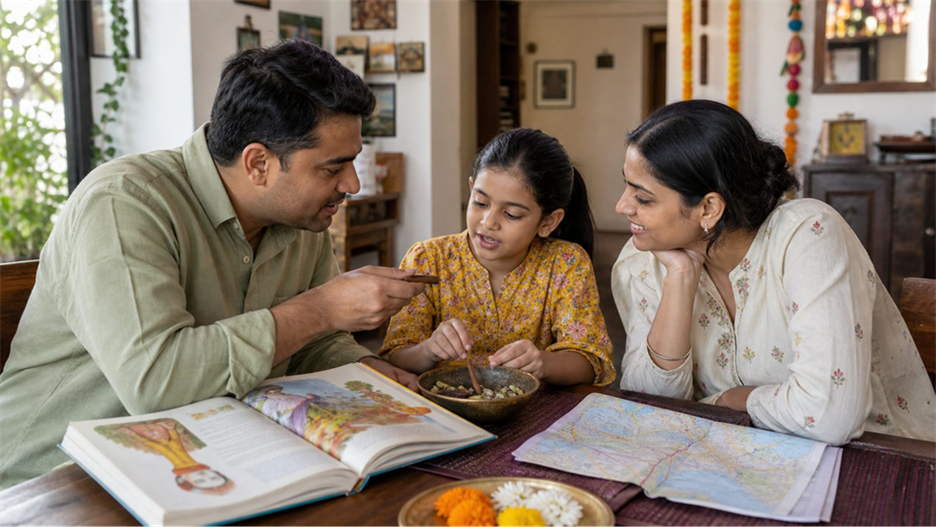
When we think about a child learning, our minds usually go to school, homework or an organised class. I see it a little differently. Children also learn while helping us prepare for a festival, asking why dosa batter rises, choosing a book or trying to read the name of a metro station.
These moments already exist in family life. We do not need to convert them into lessons or add another task to a child’s week. We need to notice the questions hiding inside them and give the child room to participate.
Give children a real role during festivals
Festivals bring together stories, numbers, colours, music, food and family memory. Children learn far more by taking part than by listening to a long explanation.
Before Diwali, a younger child can sort diyas by size or make a simple rangoli pattern. An older child can help plan the gifts within a small budget. During Eid, a child can measure ingredients for seviyan and prepare a plate for a neighbour. At a Durga Puja pandal, parents can ask the child to notice how the artist has used colour, fabric and light. A family preparing an Onam pookalam or Navratri golu can let the child arrange one section and explain the choice.
The job should be real, even if it is small. Children know when we are giving them pretend work. Carrying the flower basket, checking a shopping list or asking a grandparent about an old custom gives them a reason to pay attention.
One good question is enough: “How did our family celebrate this when you were a child?” The answer may open a conversation about a village, a language, a family move or a tradition that has changed. None of it needs to feel like school.
Let a book lead somewhere
Parents often ask children what they learnt from a book. I find that a less direct conversation works better. Ask which character they would invite home, what they would change about the ending or whether the story reminds them of someone they know.
A Panchatantra tale may lead to a discussion about whether the clever character was also fair. A story set in the hills may make a child curious about mountain homes or local food. A biography of a sportsperson may send them looking for the athlete’s hometown on a map.
The useful part is not a perfect summary. It is seeing where the child’s attention goes next.
Books can also connect with family history. If a story mentions a train journey, share a memory from your first long train ride. If it uses an unfamiliar word in Hindi, Bengali, Kannada or another language, ask someone at home how they would say it. The book becomes the start of a conversation rather than another comprehension exercise.
And sometimes a child simply wants to enjoy the story. That is fine too. We do not have to extract a lesson from every page.
Use the kitchen as it is
The kitchen gives children a practical view of maths and science because the result matters. The rotis need the right amount of flour, the lemonade should not be too sour and the cake must come out of the oven on time.
A six-year-old can count tomatoes, wash coriander or arrange idlis on plates. An older child can halve a recipe, compare prices on two packets or judge whether one bowl of batter will be enough. Fermentation is easier to grasp after watching idli or dhokla batter change overnight. Melting ghee and seeing it firm up later makes a change of state visible.
Food also carries family history. Why does one home cook with mustard oil while another uses coconut oil? Why is khichdi comfort food for one family and curd rice for another? A visit to the local vegetable market can bring up seasons, weights and the different names Indians use for the same ingredient.
Give the child one manageable responsibility: wash, measure or serve. Participation matters more than a spotless kitchen.
Treat a nearby outing as exploration


Leave a Reply