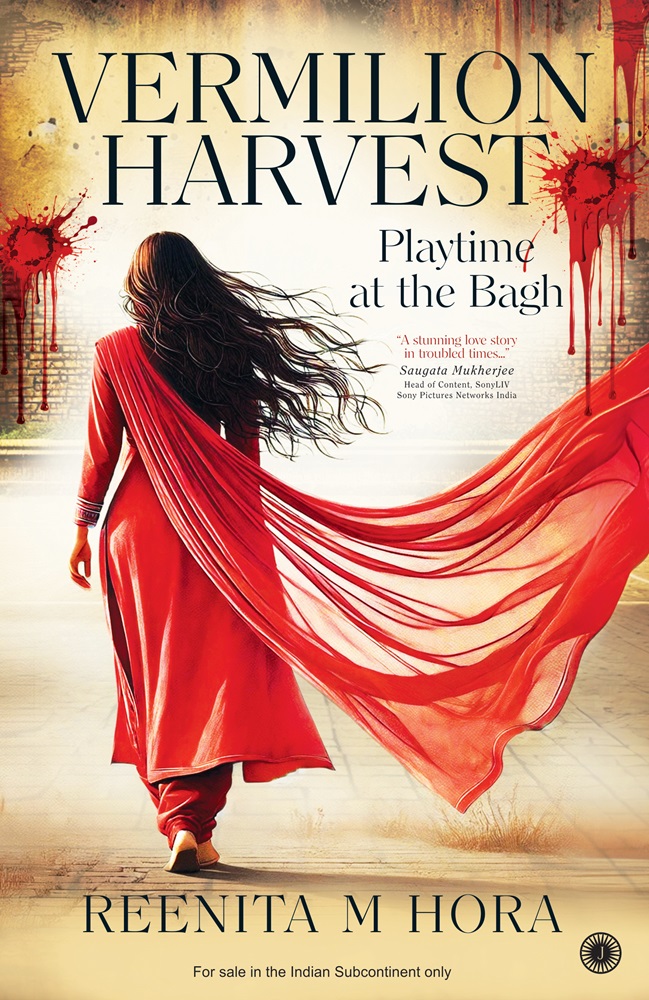
Vermilion Harvest by Reenita M. Hora- Book Review
Posted by admin
On April 10, 2026
Vermilion Harvest by Reenita M. Hora- Book Review
Amazon
When I picked up Vermilion Harvest by Reenita M. Hora, I expected a historical novel. But wait! What I experienced was something far more intimate and emotionally layered.
Set against the backdrop of colonial India, the story beautifully intertwines personal identity, forbidden love, and political awakening.
From the very first chapter, I felt transported into the streets of Amritsar in 1919, where every moment carries both tenderness and tension.
Premise – Vermilion Harvest
At its core, the novel explores the life of Aruna, a young Anglo-Indian woman struggling to find her place in a society divided by race, religion, and colonial rule. As India moves toward independence, Aruna’s personal journey mirrors the larger national conflict. Her relationship with Ayaz, a Muslim political activist, becomes the emotional anchor of the story. Well, the book also highlights the societal barriers that threaten to tear them apart.
Plot -Vermilion Harvest
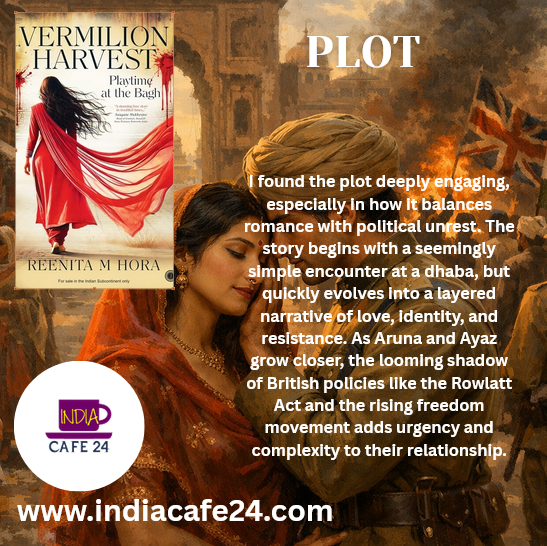
I found the plot deeply engaging, especially in how it balances romance with political unrest. The story begins with a seemingly simple encounter at a dhaba, but quickly evolves into a layered narrative of love, identity, and resistance. As Aruna and Ayaz grow closer, the looming shadow of British policies like the Rowlatt Act and the rising freedom movement adds urgency and complexity to their relationship.
What stood out to me was how the narrative doesn’t rush and it allows moments to breathe. Their walks, conversations, and stolen glances carry as much weight as the larger political developments. The plot feels less like a sequence of events and more like an emotional journey unfolding against history.
Character Development – Vermilion Harvest
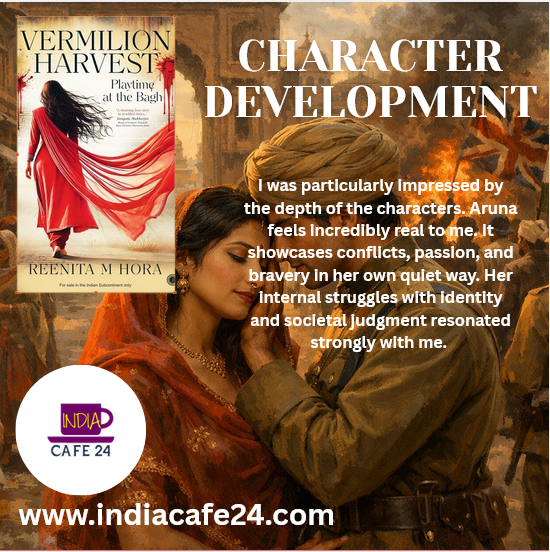
I was particularly impressed by the depth of the characters. Aruna feels incredibly real to me. It showcases conflicts, passion, and bravery in her own quiet way. Her internal struggles with identity and societal judgment resonated strongly with me. Why I say so because I face so when I move from Bengal to North. My pronunciation of Hindi, my opinions about life, my simple lifestyle- all were under the judgment of the locals. It took time to establish my identity, but I did.
Ayaz, on the other hand, is charismatic and idealistic, yet grounded in purpose. His political awareness and emotional intelligence make him more than just a romantic lead.
Even the supporting characters, especially Aruna’s mother and Amrita, add richness to the story. They represent different perspectives of society, tradition, fear, practicality and that makes Aruna’s choices even more compelling.
Writing Style – Vermilion Harvest
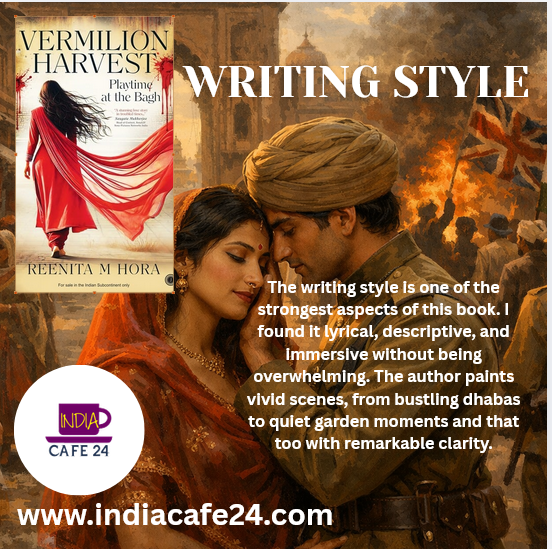
The writing style is one of the strongest aspects of this book. I found it lyrical, descriptive, and immersive without being overwhelming. The author paints vivid scenes, from bustling dhabas to quiet garden moments and that too with remarkable clarity.
What I loved most was the use of dialogue. It feels natural yet layered with meaning, often revealing deeper emotional and social tensions. The subtle references to literature (like Pride and Prejudice) add intellectual charm and deepen the bond between characters.
The pacing is deliberate, allowing me to fully absorb both the emotional and historical context.
Final Verdict- Vermilion Harvest
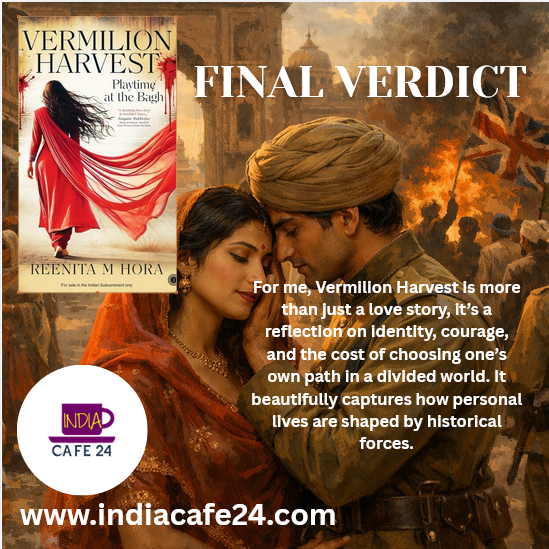
For me, Vermilion Harvest is more than just a love story, it’s a reflection on identity, courage, and the cost of choosing one’s own path in a divided world. It beautifully captures how personal lives are shaped by historical forces.
I would highly recommend this book to anyone who enjoys historical fiction with emotional depth and strong character arcs. It left me thoughtful, moved, and eager to see how Aruna’s journey unfolds further. For me its 4/5 stars read and enjoyed it.
TOPICS Book ReviewReenita M. HoraVermilion Harvest



Leave a Reply